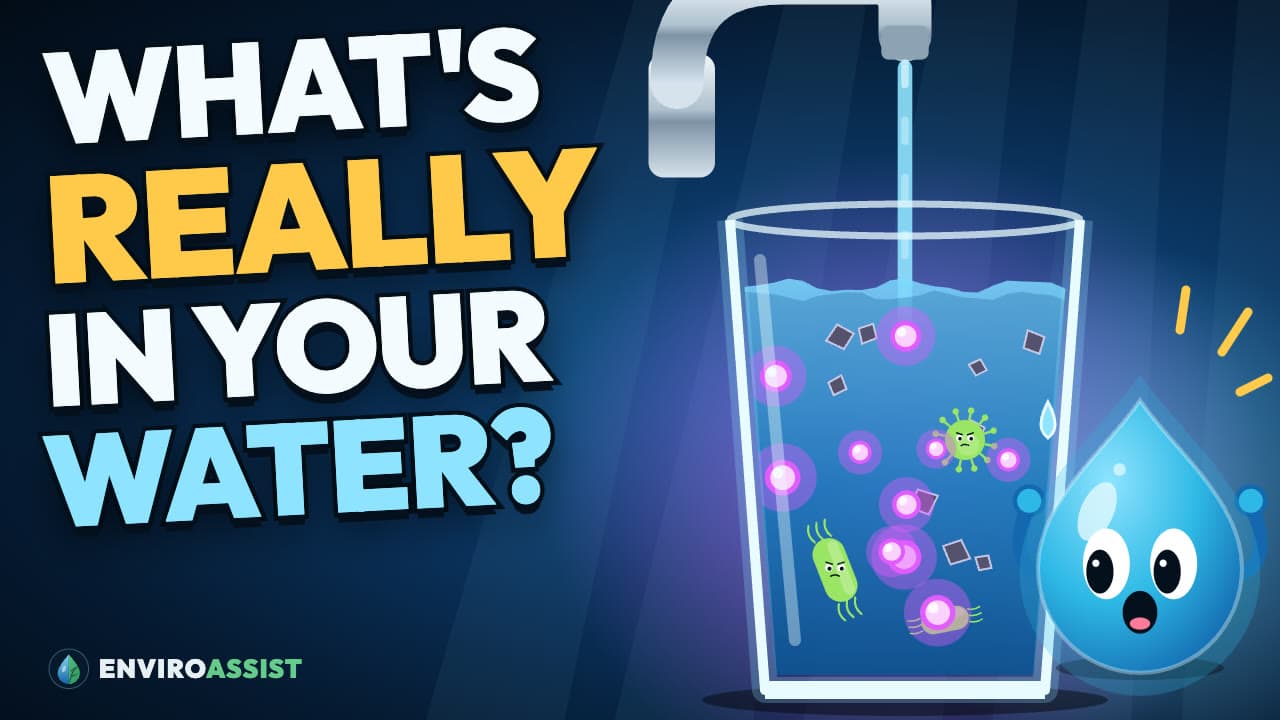
This is a glass of tap water. Clear, clean, kind of boring. But the water inside it is older than the dinosaurs, and some of it may be older than the Sun.
Over billions of years, the same molecules have been ocean waves, glacier ice, Amazon rain, and almost certainly the inside of a dinosaur or two. And in just the past few weeks, this water fell from a cloud, ran across fields and city streets, got pulled out of a river, scrubbed, zapped, tested, and pushed through miles of underground pipe to reach your kitchen.
So what can sneak into it on the way? How does a treatment plant get it out? And what might still be in your glass right now? Let’s follow one drop of water, all the way from the sky to your tap.
CHAPTER 010:56 in the video
The Water Cycle
Earth holds about 332 million cubic miles of water. Sounds like plenty. But about 97 percent of it is salty ocean water, and of the fresh water that’s left, more than two-thirds is locked up in ice caps and glaciers. Most of the rest is hidden underground.
Try it
Shrink Earth's water into a gallon jug
Step through the four views to see how little of it we can actually use.
Step 1 of 4
332 million
cubic miles of water on Earth
Oceans, ice, rivers, groundwater, clouds, and every living thing. Sounds like plenty.
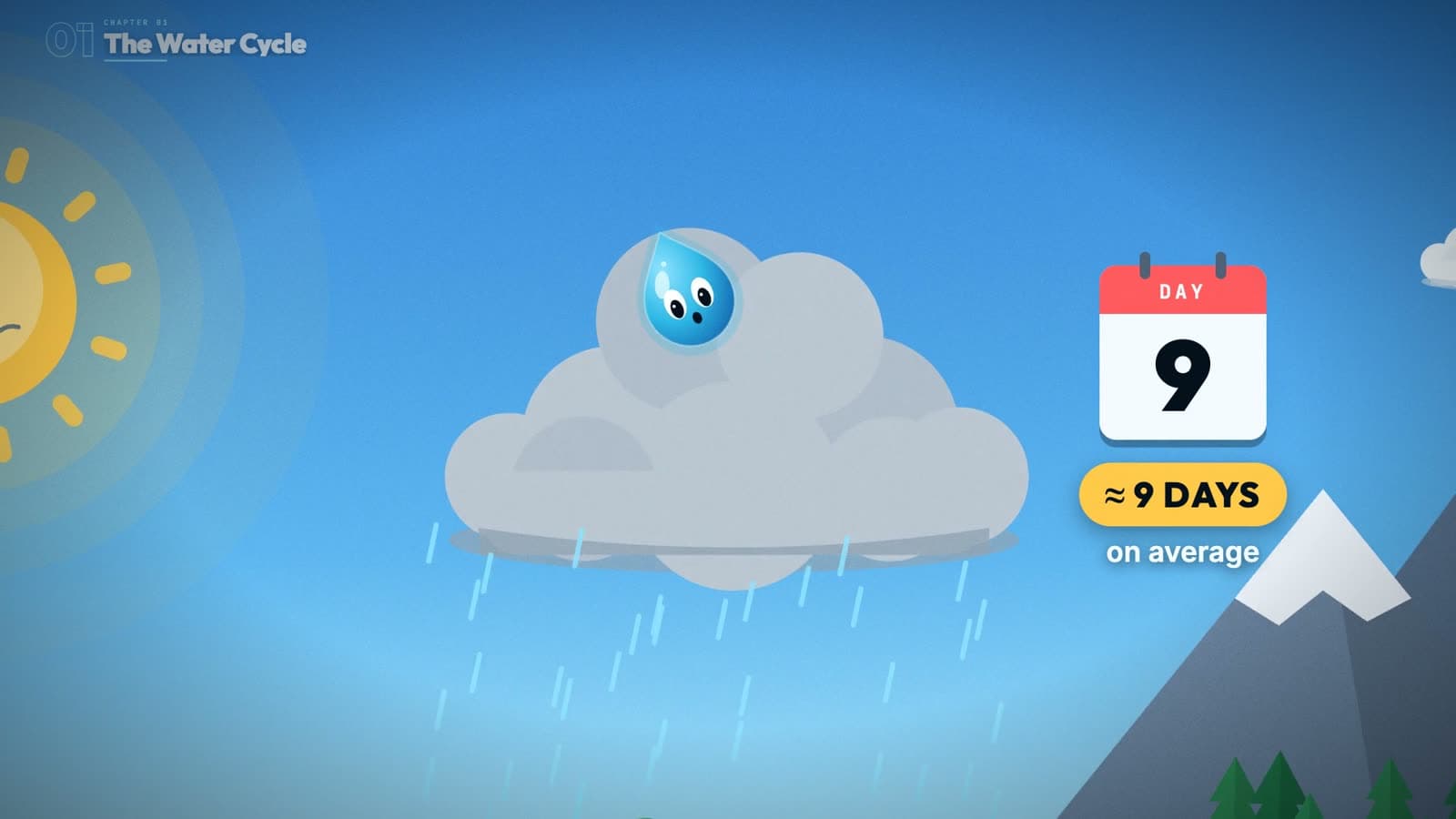
Those two tablespoons are all we’ve ever had. The planet just keeps recycling them, and the machine that does it is the water cycle. The clever part: when water evaporates, it leaves salt and most impurities behind. The sun is running the biggest water distiller on the planet.
Try it
Follow a drop around the water cycle
Click the numbered stops, or press Tour to let the drop make the trip on its own.
Stop 1 of 7
Evaporation
The sun heats oceans, lakes, and soil, and water rises into the air as invisible vapor. Salt and most impurities stay behind.
The sun runs the biggest water distiller on the planet.
CHAPTER 022:37 in the video
What Gets In
From the moment our drop leaves the cloud, it starts picking up hitchhikers. It falls through air carrying dust, soot, and pollution. Then it lands, and the real road trip begins.
Try it
Meet the usual suspects
Open each suspect's case file: who they are, where they come from, and why they matter.
Pick a suspect
1 of 8 case files read
Case file · Suspect no. 1 · Off the land
Microbes
- Who
- Bacteria like E. coli, viruses, and tough little parasites like Giardia and Cryptosporidium.
- Comes from
- Sewage overflows, leaky septic systems, and animal waste.
- Why it matters
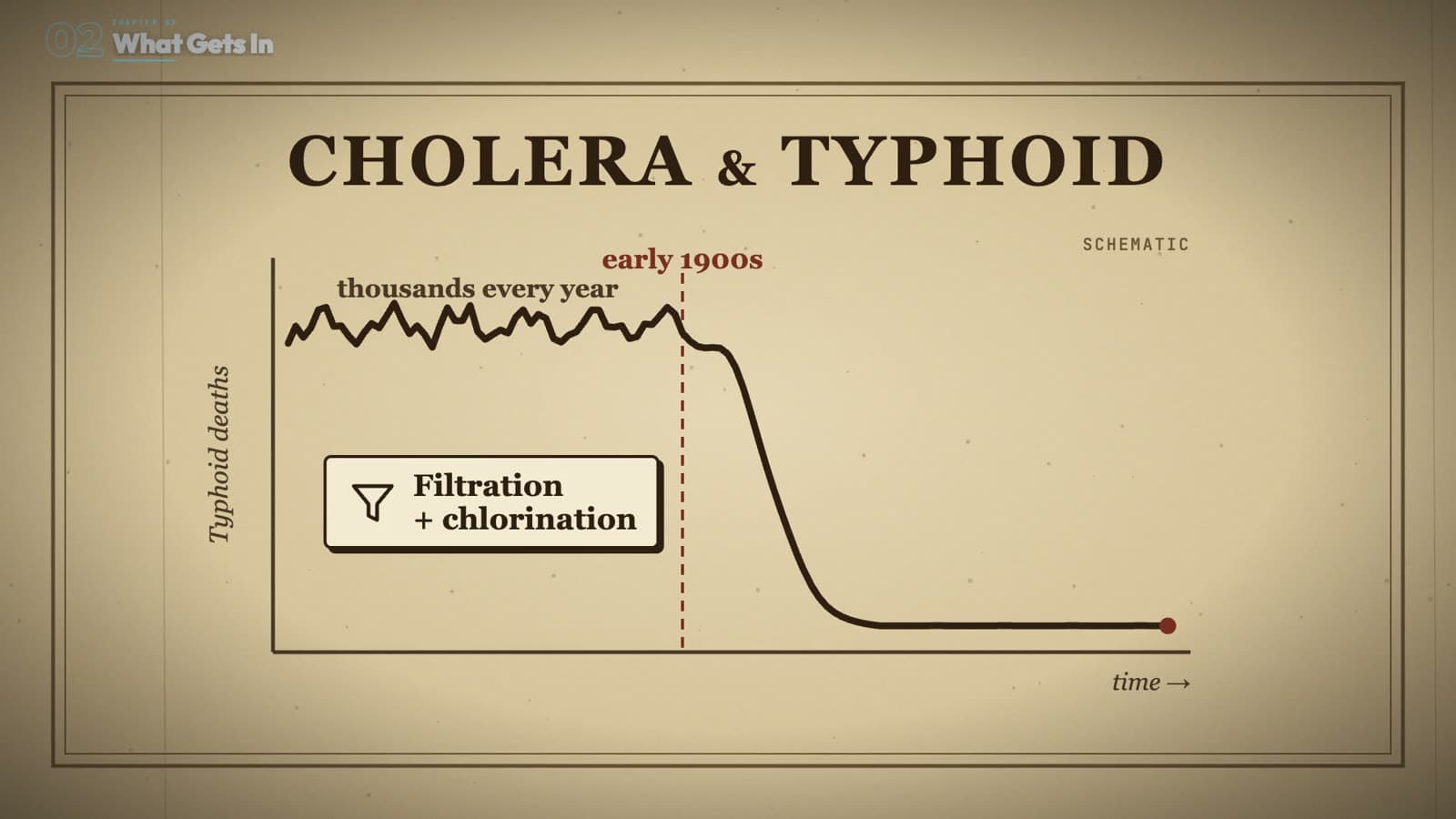
- For most of history, the deadliest thing in water. Cholera and typhoid killed thousands of Americans every year until the early 1900s, when cities started filtering and chlorinating their water: one of the biggest public health wins of all time.
Now, the amounts we’re talking about are tiny. Some contaminants are measured in parts per million, some in parts per billion, and PFAS in parts per trillion. That’s why a treatment plant’s job isn’t just to make water look clean. It has to remove things you will never, ever see.
Try it
How small is a part per trillion?
Switch between the three scales. Each one is a single drop.
Parts per million
1 drop in about 13 gallons
One drop is about 0.05 mL, so the container holds ≈ 50 liters.
1 ppm = 1 milligram per liter (mg/L)
Nitrate's legal limit is 10 ppm (as nitrogen).
CHAPTER 034:59 in the video
The Treatment Plant
Our drop ends up in a river, lake, or reservoir. That’s where most Americans on public water systems get their water; everyone else pumps it up from underground. Either way, the trip into the treatment plant starts at an intake, where big screens catch sticks, leaves, trash, and the occasional confused fish. Then pumps lift the water into the plant for a series of steps that are honestly kind of brilliant.
Try it
Run the treatment plant
Take one tank of river water through all five steps and watch where the dirt and germs go.
Raw river water
The intake screens already caught the sticks, leaves, trash, and the occasional confused fish. What's left is clay, silt, algae, and bacteria so tiny they never settle on their own. Most carry a slight negative charge, so they push each other away, like magnets that refuse to touch.
Takes
- Before treatment
Looks
- Muddy
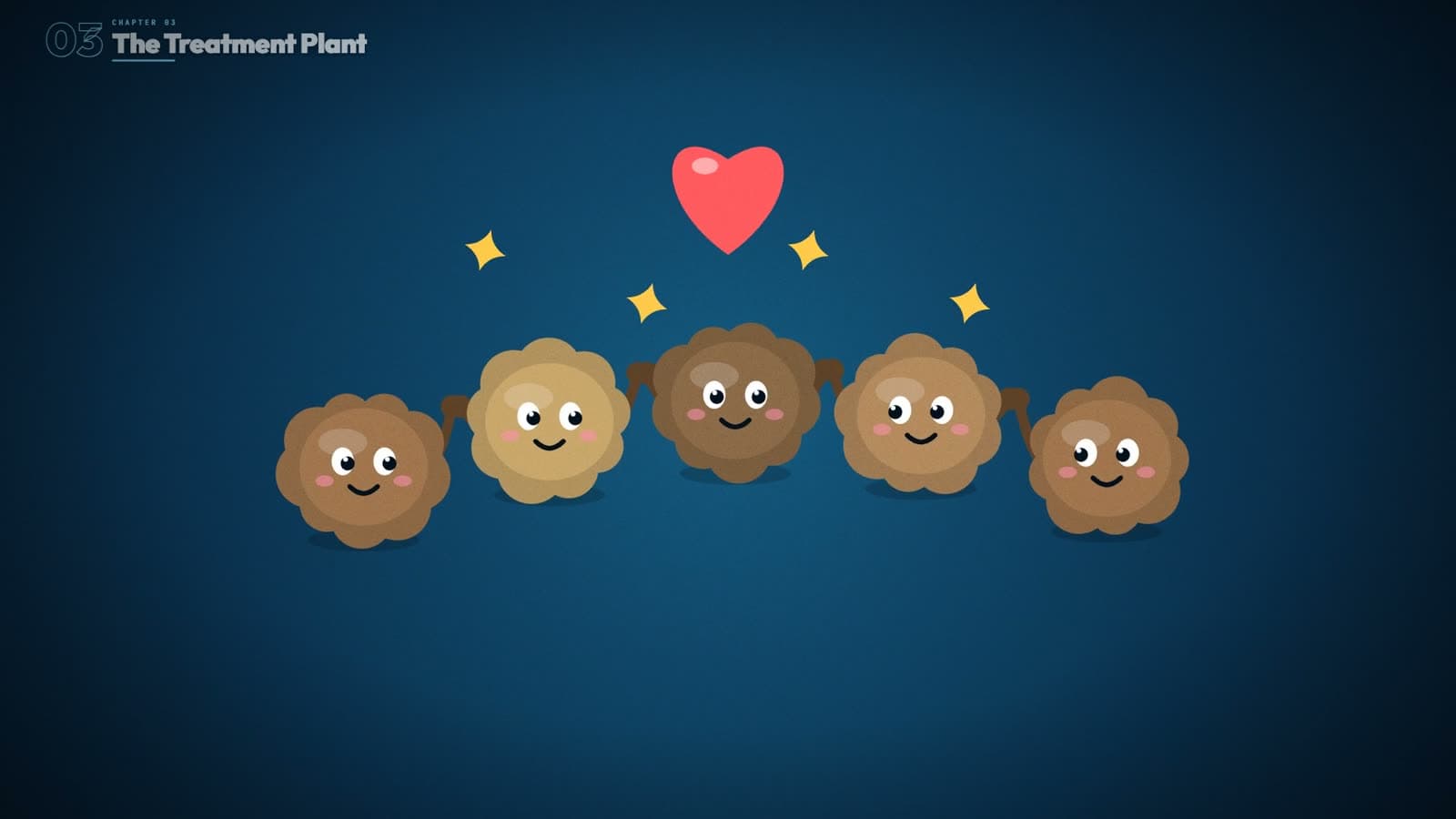
By the end of filtration, our drop looks crystal clear. But looking clean and being safe are two very different things. That’s what disinfection is for, and it’s where some germs fight back.
Try it
Germs vs. barriers
Pick a germ and a disinfectant. Can it get through?
1. Pick a germ
2. Pick a barrier
Germ gets through
Shrugged off. Cryptosporidium hides inside a tough outer shell and can survive in chlorinated water for days. In 1993 it slipped through a plant in Milwaukee and made more than 400,000 people sick.
CHAPTER 048:54 in the video
Through the Pipes
Our drop is clean, but it’s still miles from your house. Powerful pumps push it into large transmission mains, which branch into smaller distribution mains under your streets. Altogether, the U.S. has more than 2 million miles of drinking water pipe: enough to wrap around the Earth more than 80 times.
Some of that water gets pumped up into storage tanks and water towers. And water towers are genius, because they run on gravity.
Try it
Raise the water tower
Drag the height, then cut the power and watch what happens to the pressure at the tap.
Pressure at the tap
≈ 65 psi
150 ft × 0.433 psi per foot. The pumps are on.
But a lot of these pipes are old. Like, really old. Some early American cities piped water through hollowed-out logs, and many still use cast iron mains laid a century ago, alongside newer ductile iron and plastic pipe. Old pipes break, and leaks waste billions of gallons of treated water every day.
Try it
Main breaks, while you read
An estimate based on about 240,000 breaks a year. Keep reading; it keeps counting.
Since you opened this page · 0:00
The next U.S. water main break is probably minutes away.
At about 240,000 a year, that’s one roughly every two minutes. The ring fills toward the next one. An average, not a live feed.
Breaks aren’t just wasteful. When pressure drops, dirty water from the soil around a cracked pipe can get sucked inside. That’s why a big main break often comes with a boil-water notice.
Even in good pipes, water changes on the way. Most of it reaches you within a day or two, but at the far edges of some systems it can be more than a week old. Along the way, the chlorine bodyguard slowly wears out, and slimy films of bacteria called biofilm cling to the pipe walls.
Try it
The balancing act
Set how much chlorine the plant adds and how long the water travels. Can you keep both sides in check?
Protection left at your tap
Byproducts formed
Balanced
Enough residual to keep protecting the water all the way to your tap, without piling up byproducts. Utilities test constantly to stay here.
An illustrative model of the trade-off, not real chemistry. Most water reaches homes within a day or two; at the far edges of some systems it can be more than a week old.
CHAPTER 0511:07 in the video
The Last 100 Feet
Finally, our drop turns off the main and into a small pipe called a service line, which runs under your yard and into your home. And for millions of homes, that service line is made of lead.
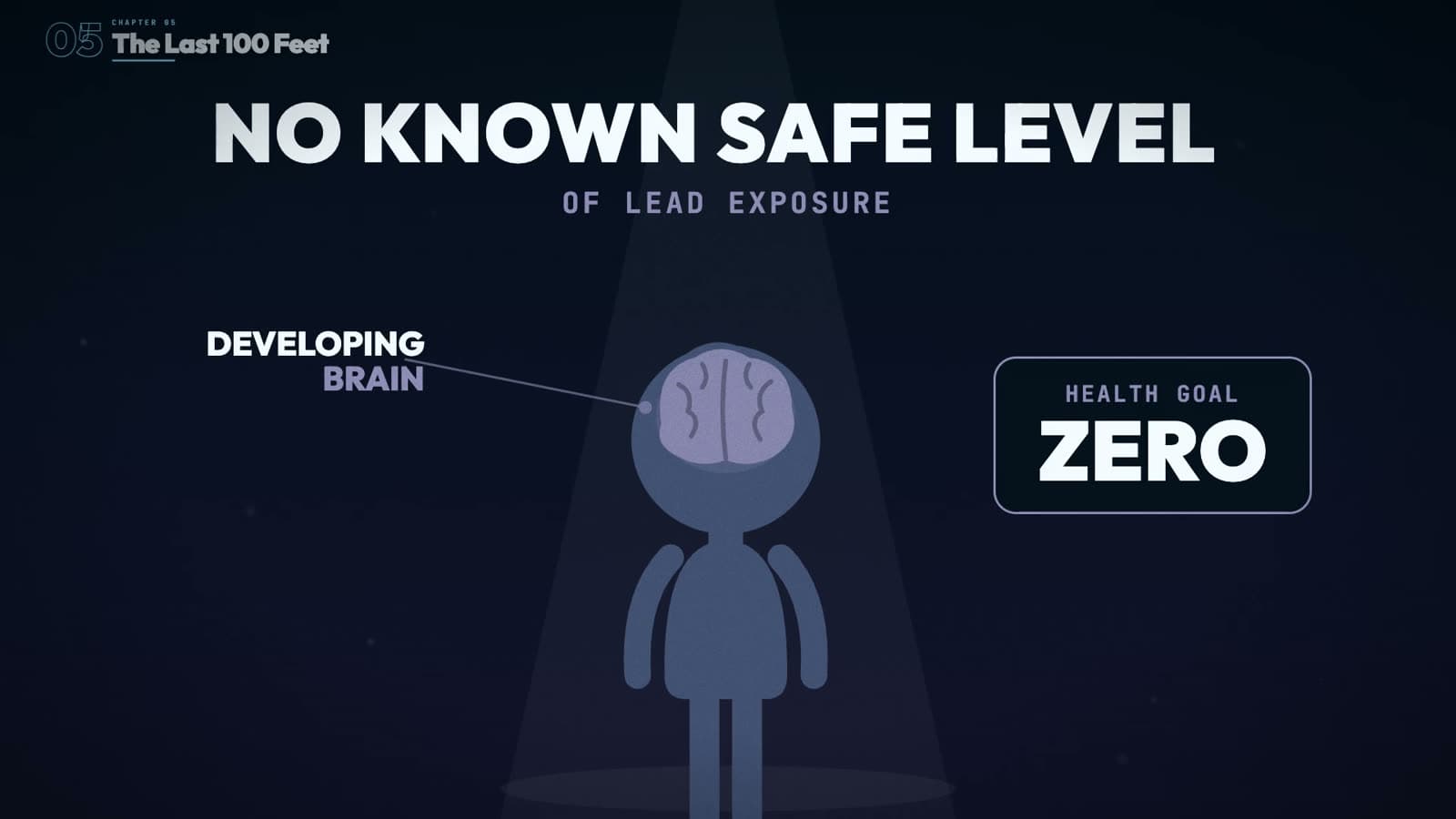
Lead was the go-to plumbing material for centuries: soft, easy to bend, and long-lasting. The word plumbing even comes from the Latin word for lead, plumbum. The problem: there’s no known safe level of lead exposure, especially for kids. It can harm the developing brain, and that damage can’t be undone.
- Lead pipes banned for new installation. The old ones were never dug up.
- 1986Lead pipes banned for new installation. The old ones were never dug up.
- Lead service lines still in the ground (EPA estimate, 2025)
- ≈ 4MLead service lines still in the ground (EPA estimate, 2025)
- Federal goal for replacing most of them (rule challenged in court)
- ≈ 10 yrsFederal goal for replacing most of them (rule challenged in court)
Remember the protective coating the treatment plant builds inside pipes? This is where it matters. In 2014, Flint, Michigan switched its water source to save money, without adding corrosion control. The new water ate away the protective scale inside old pipes, and lead flowed straight into people’s homes. Same pipes. Different chemistry. A full-blown public health crisis.
Since then, utilities have had to map every service line, and many post the maps online. You can also check the pipe yourself, where it enters your house.
Try it
Is your service line lead?
Answer three questions about the pipe where water comes into your house.
Answer the questions to see what your pipe is probably made of.
Lead can also come from inside the house: old lead solder on copper pipes, and certain brass faucets and fittings, especially in homes built before 1986.
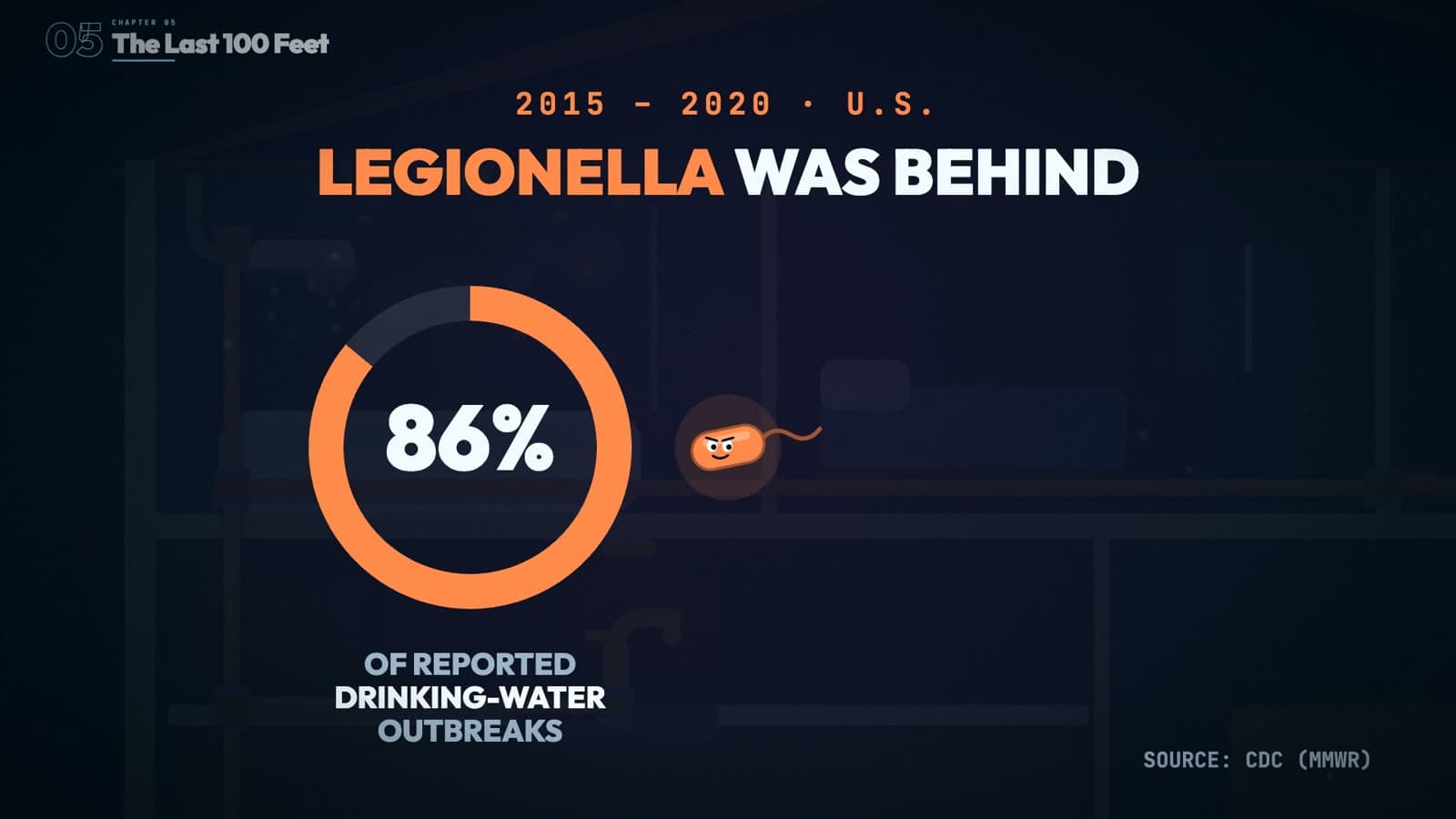
And one more thing loves home plumbing: Legionella. This bacterium thrives in warm, stagnant water, like water heaters set too low or pipes nobody uses. Breathed in as a fine mist, say from a shower, it can cause a severe pneumonia called Legionnaires’ disease.
CHAPTER 0613:13 in the video
What's Left in Your Glass
So after all that, what’s actually in your glass? First, the good news: tap water in the U.S. is among the safest in the world. Utilities monitor for more than 90 regulated contaminants under the Safe Drinking Water Act. For each one, the EPA sets a health goal, the level with no known risk, and an enforceable legal limit, set as close to that goal as is practical.
Try it
Health goal vs. legal limit
Compare the two numbers for three contaminants.
Arsenic
No level of arsenic is known to be risk-free, so the goal is zero. The enforceable limit is 10 ppb: as close to zero as treatment can practically get.
Depending on where you live, a few things can still make it into your glass:
- Disinfection byproducts, usually at low, regulated levels.
- Lead, if your home has a lead service line or old plumbing.
- Nitrates and arsenic, especially in farm country and certain groundwater regions.
- PFAS. A USGS study estimated at least 45% of U.S. tap water contains one or more. In 2024 the EPA set the first national limits, as low as 4 parts per trillion, but it has since proposed scaling that rule back, and the deadlines are still being fought over.
- Microplastics, which aren’t regulated yet. Scientists are still working out what they mean for our health.
And then there’s stuff that sounds scary but mostly isn’t.
Try it
Sounds scary, or worth checking?
Sort each one. You'll see why after every answer.
Mostly harmless, or worth checking?
0 of 7 sorted
A chlorine smell
Lead
Cloudy water that clears as it sits
Nitrates
White crust from hard water
PFAS
Arsenic
CHAPTER 0714:56 in the video
What You Can Do
So, what can you actually do? Here are five steps you can start today. Tick them off as you go.
0 of 5 done
1Read your water quality report
Every community water system has to publish one each year, called a Consumer Confidence Report. Search your utility’s name plus “water quality report.” It shows what they found and how it compares to the legal limits.
2Find out what your service line is made of
Utilities have had to inventory their lines, and many post online maps. Or try the scratch and magnet check in Chapter 5 on the pipe where it enters your house.
3Build a few simple habits
If water’s been sitting in the pipes for hours, run the cold tap for a bit before drinking. Use cold water for cooking and baby formula, since hot water pulls more lead from pipes. And clean your faucet aerators.
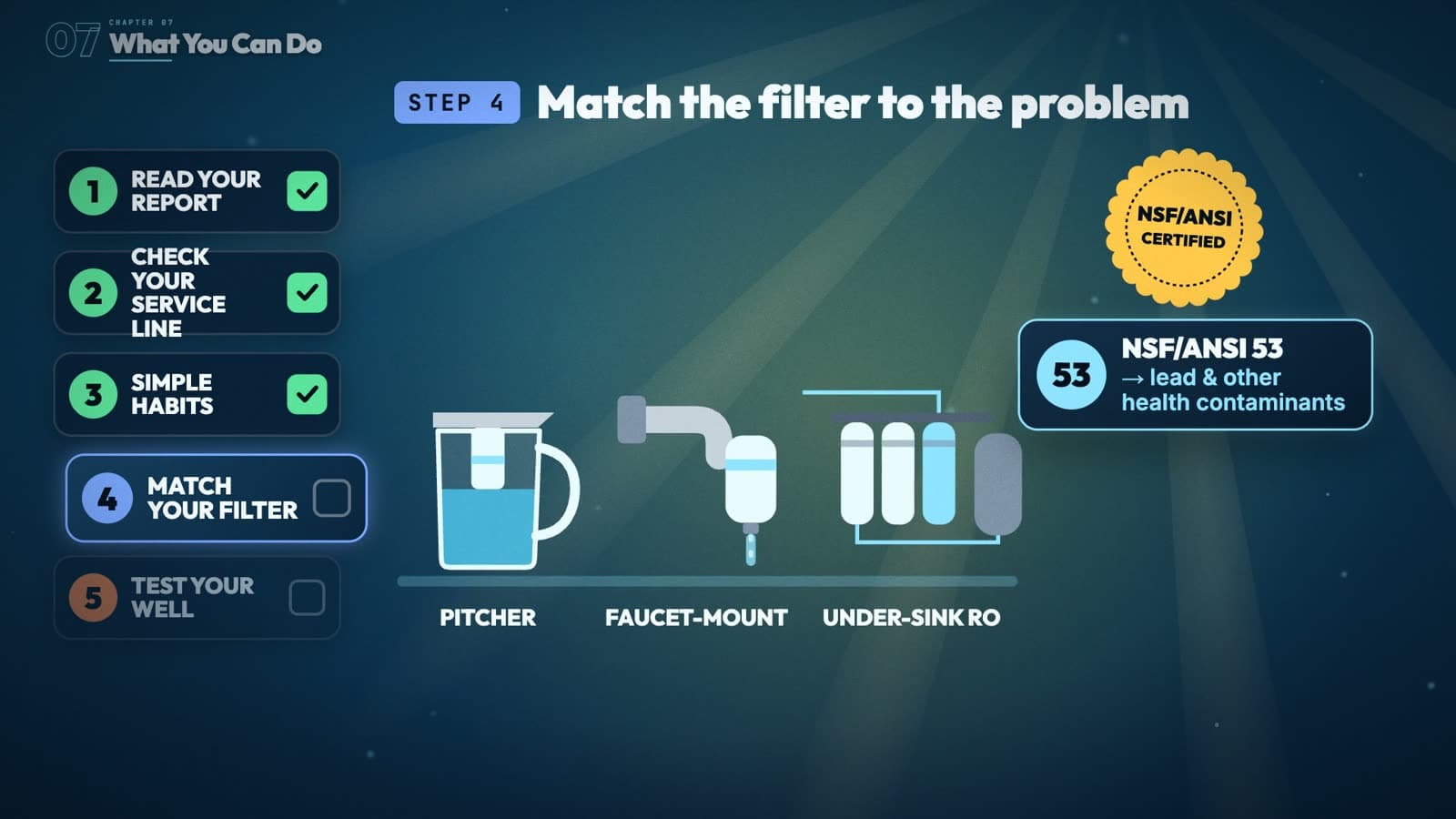
4If you want a filter, match it to the problem
Look for NSF/ANSI certification, and check what yours is actually certified for. Not every filter removes everything.
What do you want to remove?
Look for: NSF/ANSI 53
Standard 53 covers health contaminants like lead. Check that lead reduction is on the filter's list of certified claims. Reverse osmosis systems are certified under Standard 58.
5On a private well? Test it
Every year for bacteria and nitrates, and every few years for things like arsenic.
So next time you fill a glass, think about the trip it took: a cloud, a river, coagulation, filtration, disinfection, miles of pipe, a water tower, and the last few feet into your kitchen. When it goes down the drain, the journey starts over: to a wastewater plant, back into a river, and up into the sky.
But some contaminants don’t cycle out so easily. One family of chemicals is so persistent that scientists call them forever chemicals. That’s the next lesson.
QUICK QUIZ
Follow the drop: what did you catch?
Six questions. Every answer comes with the why.
Question 1 of 6
Squeeze all of Earth's water into a one-gallon jug. How much is fresh water we can actually reach and use?
SOURCES
Where these facts come from
Every fact in the video and on this page was checked against these sources on October 19, 2026. Rules and research keep moving, so check the newest version of anything you plan to act on.
Show all 16 sources
- USGS Water Science School: Where is Earth's Water? / How much water is there on Earth?
- van der Ent & Tuinenburg (2017), Hydrology and Earth System Sciences: atmospheric residence time of water (~9 days)
- Cleeves et al. (2014), Science: much of Earth's water may predate the Sun
- U.S. EPA: Information about Public Water Systems; National Primary Drinking Water Regulations
- U.S. EPA: Private Drinking Water Wells
- ASCE 2025 Report Card for America's Infrastructure: Drinking Water (C-; ~240,000 main breaks/yr)
- U.S. EPA (Nov 2025): 7th Drinking Water Infrastructure Needs Survey update (~4 million lead service lines)
- U.S. EPA: Lead and Copper Rule Improvements (2024)
- U.S. EPA: PFAS National Primary Drinking Water Regulation (2024); proposed revisions (Federal Register, May 20, 2026)
- USGS (2023), Smalling et al.: PFAS detected in at least 45% of U.S. tap water
- CDC: Cryptosporidium chlorine tolerance; Mac Kenzie et al. (1994), NEJM: Milwaukee outbreak
- U.S. EPA Office of Inspector General, Report 18-P-0221: Flint, Michigan
- CDC MMWR Surveillance Summaries 73(1), 2024: Waterborne disease outbreaks associated with drinking water, 2015–2020
- U.S. EPA WaterSense: average residential water rates
- NSF International: NSF/ANSI 42, 53, 58 drinking water treatment standards; U.S. EPA: Identifying filters certified to reduce PFAS
- Utah HB 81 (2025); Florida SB 700 (2025)
This lesson is for general education and isn't medical advice. Water quality varies by location; check your local utility's report for your water.
KEEP GOING