Right now, flowing through your veins, there’s probably a chemical that didn’t exist a hundred years ago.
It has been found in rain falling on Antarctica, in polar bears, and in the umbilical cord blood of newborn babies. When the CDC tests Americans’ blood, it finds these chemicals in nearly everyone. And once they get in, they’re in no hurry to leave: they break down so slowly that, on a human timescale, they basically don’t.
Scientists call them forever chemicals. Their official name is PFAS. They gave us nonstick pans, waterproof jackets, stain-proof carpets, and firefighting foam that saved lives. But some of the companies that made them had evidence of health risks decades before the rest of us did.
So where did forever chemicals come from? How did they end up in almost everyone’s blood? And what can you actually do about it?
CHAPTER 011:06 in the video
An Accidental Miracle
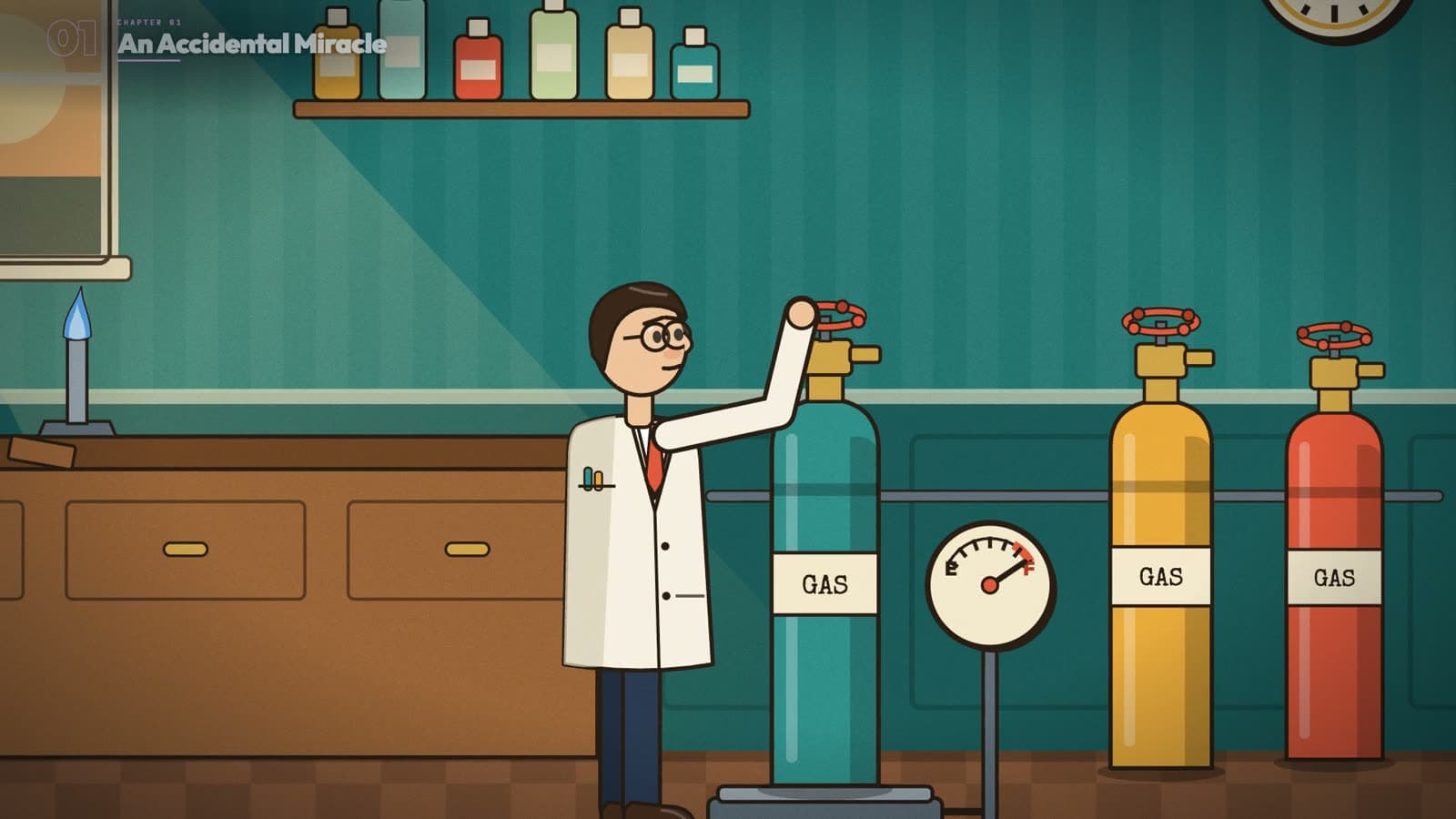
The story starts in New Jersey, in 1938. A young DuPont chemist named Roy Plunkett was working on new refrigerant gases. One morning he opened the valve on a cylinder of one of them, and nothing came out. The cylinder should have been full, so he cut it open and found the inside coated with a strange, slippery white powder.
The gas molecules had linked up into long chains, creating a material unlike anything anyone had seen. Almost nothing stuck to it. Acids couldn’t eat it. Heat barely bothered it. During World War II it even sealed equipment in the Manhattan Project that handled some of the most corrosive chemicals ever made.
After the war, DuPont gave it a catchier name: Teflon. By the early 1960s it was coating frying pans in American kitchens, and it got so famous for being slippery that in 1983 a congresswoman called President Reagan “the Teflon president,” because no scandal ever seemed to stick to him.
Meanwhile in Minnesota, 3M was cooking up its own fluorine chemistry. In 1953, a few drops of an experimental compound splashed onto a lab assistant’s canvas sneaker and wouldn’t wash off. Chemist Patsy Sherman noticed that water and oil wouldn’t stick to that spot either. That accident became Scotchgard.
3M also sold DuPont a key ingredient for making Teflon: a chemical called PFOA, nicknamed C8 for its chain of eight carbon atoms. And in the 1960s, the U.S. Navy and 3M developed a firefighting foam that could smother fuel fires in seconds. It saved lives, and for decades it was sprayed in training drills at military bases and airports.
From there, the family exploded:
- Raincoats
- Carpets
- Fast-food wrappers
- Microwave popcorn bags
- Dental floss
- Cosmetics
- Ski wax
- Smartphones
- Computer chips
- different PFAS listed in an EPA database (CompTox, 2026)
- 20,000+different PFAS listed in an EPA database (CompTox, 2026)
- PFOA's nickname, for its chain of eight carbon atoms
- C8PFOA's nickname, for its chain of eight carbon atoms
- the year a cylinder of gas turned into a slippery white powder
- 1938the year a cylinder of gas turned into a slippery white powder
Together they’re called per- and polyfluoroalkyl substances. And they all share one secret weapon. Before we get to it, here’s the whole story at a glance: the miracle, the harm, and the rules, running side by side.
Try it
Nearly ninety years of PFAS
Tap a year to read what happened. Filter to follow one thread at a time, and notice how long the harm ran ahead of the rules.
Discovery
1 / 221938
A cylinder that should have been full
In New Jersey, DuPont chemist Roy Plunkett opens a cylinder of refrigerant gas and nothing comes out. He cuts it open and finds a slippery white powder: the gas had linked into long chains that almost nothing sticks to, acids can't eat, and heat barely bothers.
CHAPTER 023:34 in the video
The Forever Bond
To see the secret weapon, zoom way, way in. This is PFOA. It’s built on a backbone of carbon atoms, and every one of those carbons is wrapped in fluorine.
Fluorine is the most electronegative element on the periodic table. Basically, it’s the greediest atom there is when it comes to electrons. When it bonds to carbon, it pulls their shared electrons in tight, forming the strongest single bond in organic chemistry.
And because the fluorine atoms are packed all the way around the chain, they form a kind of armor. Anything that might attack the carbon backbone just can’t get a grip. Bacteria that break down almost everything else can’t digest it. Sunlight barely touches it. Water, acids and heat? It shrugs them off.
Try it
Test the fluorine armor
Send bacteria, sunlight, acid or heat at PFOA. Then swap the fluorine for hydrogen and try again.
Pick an attacker to send at the molecule.
Bond strength
Typical average, kJ/mol
- C–F
- 485
- C–H
- 413
- C–C
- 348
- C–Cl
- 328
Electronegativity
Pauling scale: how hard an atom pulls on shared electrons
- F
- 3.98
- O
- 3.44
- Cl
- 3.16
- N
- 3.04
- C
- 2.55
- H
- 2.20

That toughness is exactly what made PFAS so valuable. And it’s exactly what makes them a problem.
Superpower number two
That fluorine-coated tail doesn’t like water. But unlike most chemicals, it doesn’t like oil or grease either. So when you coat a surface with it, water beads up, oil beads up, and food slides right off.
Many PFAS also have a head that loves water. That makes them surfactants: molecules that crowd together at the surface of a liquid. In firefighting foam, they help spread a thin film across burning fuel, sealing it off from the air. That’s why the foam worked so well. And it’s how so much PFAS ended up soaking into the ground.
Try it
Water and oil, on three surfaces
Pick a surface and a liquid. Plain fabric, a waxy coating and a PFAS coating each handle them differently.
Repelled. Beads up too. That's the superpower: a fluorinated tail doesn't like water, and unlike most chemicals, it doesn't like oil or grease either.
Why “forever”
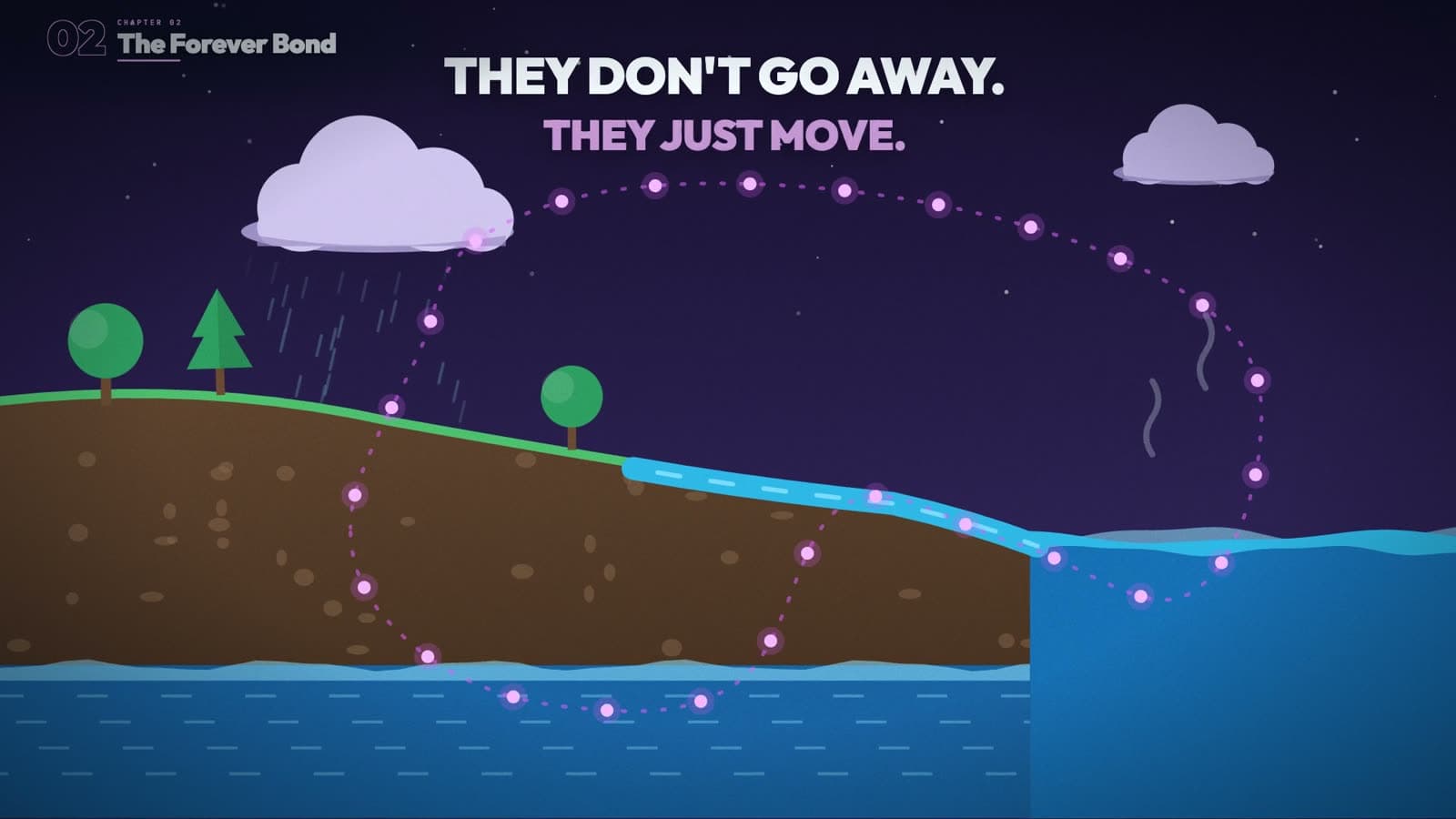
Now put it all together: a molecule nature can’t break down, that dissolves in water, and that travels easily. Once PFAS get into the environment, they don’t go away. They just move: from soil into groundwater, from rivers to the ocean, and even up into the air and back down as rain.
Inside your body, many PFAS don’t settle into fat the way a lot of other pollutants do. They latch onto proteins in your blood and build up in organs like the liver and kidneys. Your kidneys even pull some of them back into your blood instead of flushing them out. For PFOS, one of the most common, it takes years for your body to get rid of just half of it.
Try it
How long is a half-life?
Pick a PFOS half-life between three and five years, then drag time forward to see how much would still be in the body.
PFOS half-life
Still in the body
50%
after 4 years, about 1.0 half-lives
An illustration, not a prediction: it assumes no new PFOS comes in. In real life most of us keep taking in small amounts from water, food, dust and products.
CHAPTER 035:59 in the video
Into Everyone's Blood
So how did these chemicals get from factories into almost everyone’s blood? A lot of it came through water. Factories released PFAS into rivers and the air. Firefighting foam soaked into the ground at military bases and airports. Landfills full of PFAS-treated products leaked. And wastewater plants, which were never designed to remove them, passed them right through.
Try it
Every road leads to the tap
Pick a source to trace how its PFAS reached drinking water.
Factories
The route
- Smokestacks and outfalls
- Rivers and air
- Drinking water
Factories released PFAS into rivers and into the air.
- of U.S. tap water contains one or more PFAS (USGS estimate, 2023)
- 45%+of U.S. tap water contains one or more PFAS (USGS estimate, 2023)
- rain often carries PFOA above EPA's 2022 health advisory level (2022 study)
- Worldwiderain often carries PFOA above EPA's 2022 health advisory level (2022 study)
- of the Americans the CDC tests have PFAS in their blood
- Nearly allof the Americans the CDC tests have PFAS in their blood
One town’s story
To see how this played out for one community, go to Parkersburg, West Virginia, on the Ohio River.
Try it
Parkersburg, step by step
Step through how one plant, one farmer and one lawyer changed what we know about PFOA.
Step 1 of 6 · For decades
Washington Works
Not just Parkersburg
This was never just a Parkersburg problem. In 1997, a 3M scientist tested blood samples from blood banks around the country and found PFOS in every single one. When the CDC started measuring PFAS in its national health survey, it found them in the blood of nearly everyone it tested: adults and kids, all across the country.
We take them in from many directions: drinking water, food like fish, food packaging, household dust, and the products around us. Firefighters and factory workers can get much higher doses. PFAS can also pass from mother to baby, across the placenta and through breast milk. Even so, health experts still say the benefits of breastfeeding outweigh the risks.
But here’s some genuinely good news. After U.S. manufacturers phased out PFOS and PFOA, levels in Americans’ blood dropped dramatically.
Try it
Levels in Americans' blood
Switch between PFOS and PFOA to see how far each fell after they were phased out.
PFOS in blood
Down more than 85%
between 1999 and 2018
CDC NHANES · blood serum, ages 12 and up · geometric mean, ng/mL. Each chemical on its own scale. The catch: newer replacement PFAS took their place, and we know a lot less about them.
CHAPTER 0410:11 in the video
The Health Question
So what do PFAS actually do to us? In 2022, the National Academies of Sciences, Engineering, and Medicine reviewed decades of research. They sorted the health effects by how strong the evidence is: four with sufficient evidence, and more with limited evidence.
Try it
Sort the evidence
For each health effect, guess whether the National Academies found sufficient or limited evidence. Then check yourself.
Higher cholesterol
Breast cancer
Weaker antibody response to vaccines
Thyroid disease
Lower birth weight
Testicular cancer
Ulcerative colitis
Kidney cancer
High blood pressure in pregnancy
Sorted 0 of 9
WHO cancer agency · 2023
PFOA: carcinogenic to humans (Group 1, its highest category). PFOS: possibly carcinogenic (Group 2B).
U.S. EPA
PFOA and PFOS are likely carcinogens, so the health goal for both is set at zero.
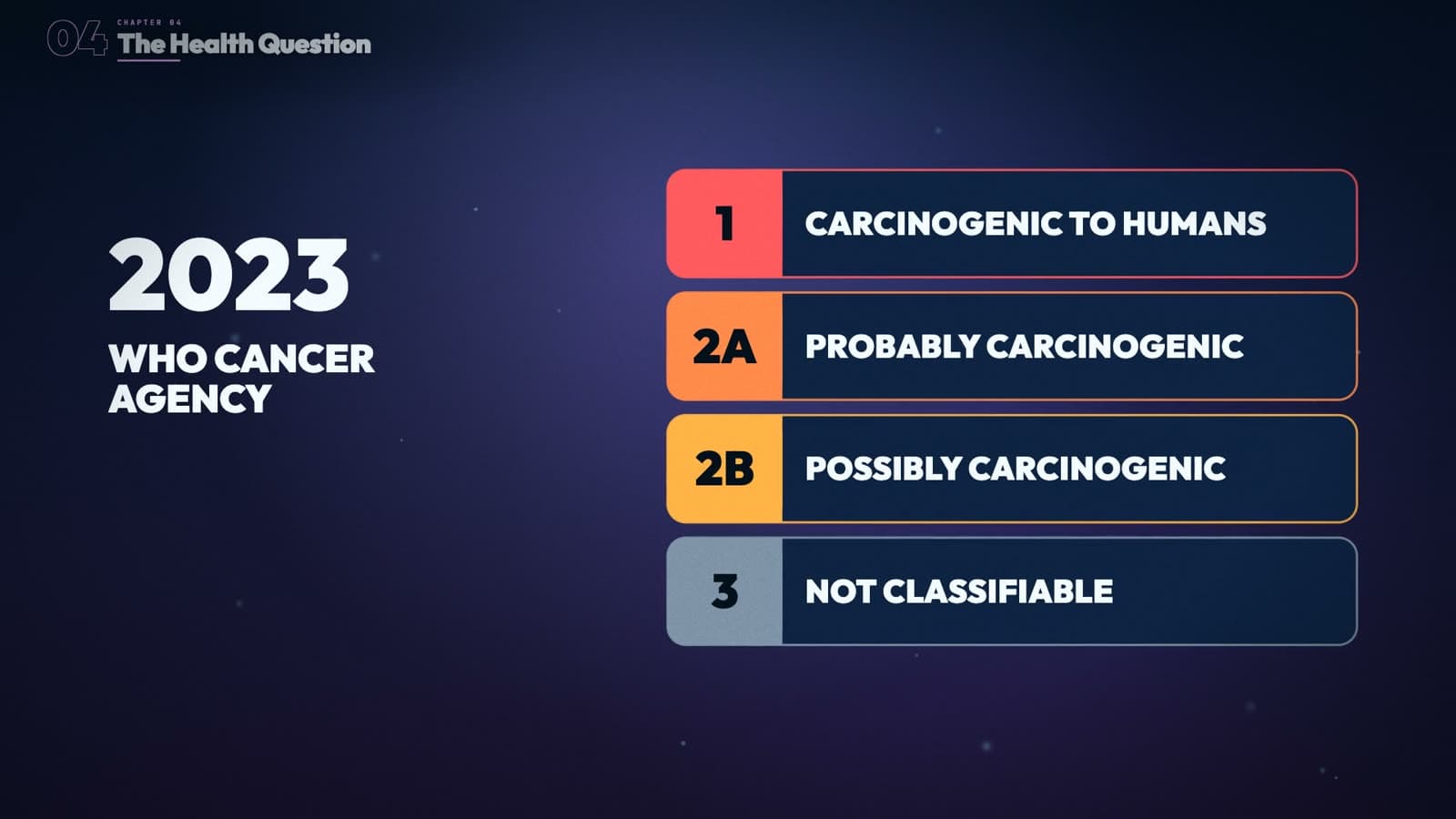
In 2023, the World Health Organization’s cancer agency classified PFOA as carcinogenic to humans, its highest category. And the EPA concluded that PFOA and PFOS are likely carcinogens, setting the health goal for both at zero.
Now, exposure isn’t the same as getting sick. Risk depends on how much you’re exposed to, and for how long. Most people have low levels. But near contaminated sites, levels can be many times higher. That’s why the National Academies recommend that doctors offer PFAS blood testing to people who are likely to have high exposure.
Try it
Reading a PFAS blood test
Slide a made-up result to see which of the National Academies' three tiers it falls in.
Under 2 ng/mL
Adverse health effects are not expected.
2 to under 20 ng/mL
Potential for adverse effects, especially in sensitive populations.
20 or more ng/mL
Higher risk of adverse effects.
At 5.0 ng/mL: Potential for adverse effects, especially in sensitive populations.
These tiers are for a doctor to interpret with you, alongside your history. Exposure isn’t the same as getting sick. The National Academies recommends doctors offer PFAS blood testing to people likely to have high exposure.
CHAPTER 0511:27 in the video
The Rules, Right Now
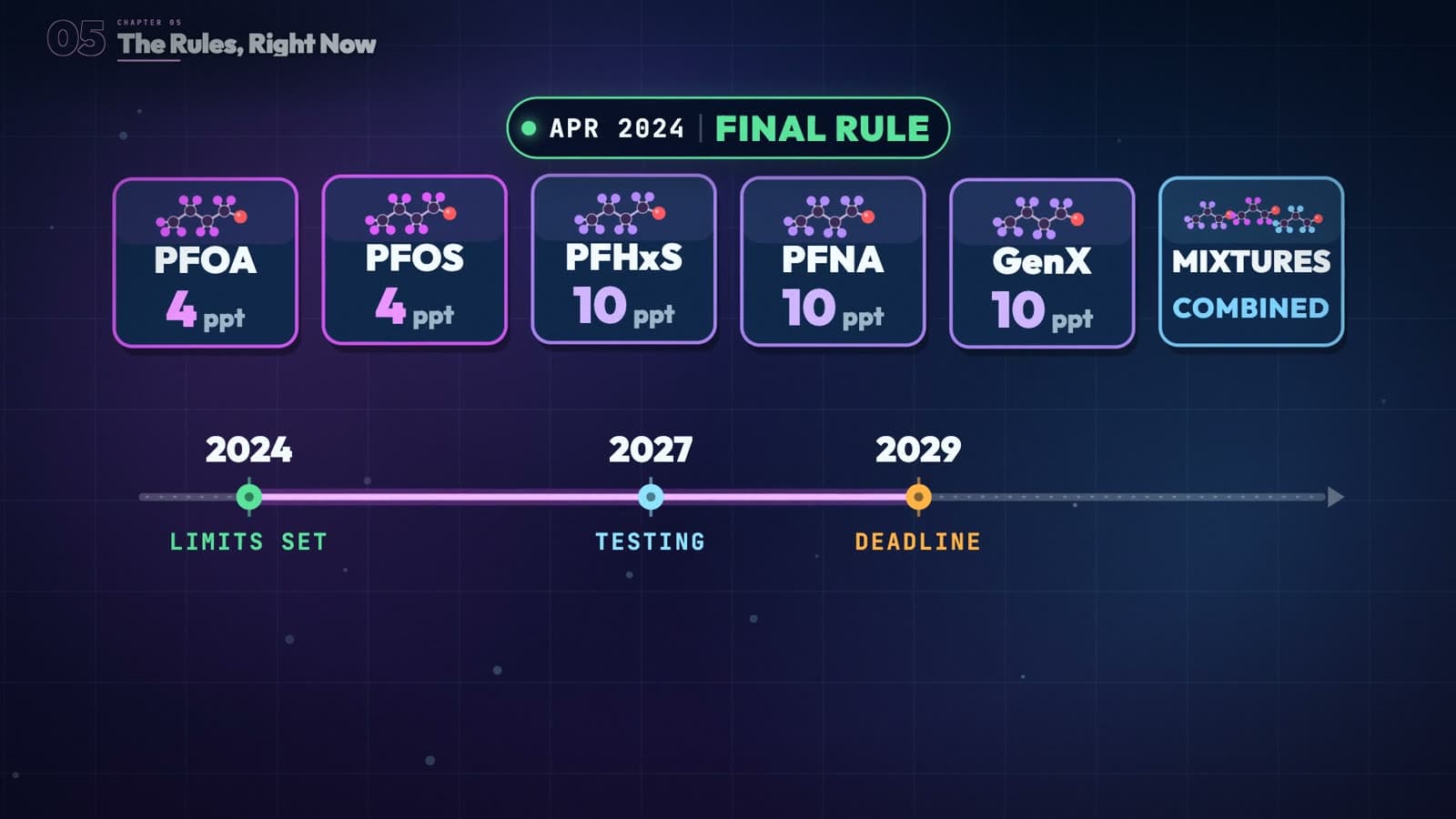
For decades, there were no national limits on PFAS in drinking water, just non-binding health advisories. That changed in April 2024, when the EPA set the first enforceable national limits.
PFOA and PFOS were capped at four parts per trillion. Three more, PFHxS, PFNA and GenX, were limited to ten parts per trillion. And a fourth limit covered mixtures that can add up together.
Then the plan changed, and it’s still changing. The board below walks through each turn, and where things stand as of October 2026.
Try it
The federal limits, then and now
Step through the 2024 rule, the 2025 announcement, the 2026 proposal, and where it all stands today.
April 2024: the first national limits
PFOA
4ppt
FinalPFOS
4ppt
FinalPFHxS
10ppt
FinalPFNA
10ppt
FinalGenXHFPO-DA
10ppt
FinalMixturesHazard Index
1HI
Final
- 2024Limits set
- 2027Testing
- 2029Deadline
The EPA set the first enforceable national drinking water limits for PFAS. Water systems had until 2027 to start testing and until 2029 to fix any problems. The EPA estimated the rule would cut PFAS exposure for about 100 million people.
How small is 4 ppt?
Four parts per trillion is like a single drop of water spread across five Olympic-size swimming pools.
A separate case · Aug 2026
The same court upheld listing PFOA and PFOS as hazardous substances under the Superfund law, which helps make polluters pay for cleanups.
The mixture limit, by the numbers
The fourth limit is the least intuitive. It covers PFHxS, PFNA, GenX and a fourth chemical, PFBS. Each one’s level is divided by a health-based number, and the shares are added up into a hazard index. If the total tops 1, the water is over the limit, even if every chemical is under its own.
Try it
Add up a hazard index
Try the made-up samples, or drag the levels yourself, and watch the shares add up against the limit of 1.
Made-up samples
Own limit 10 ppt · counts as level ÷ 10
Own limit 10 ppt · counts as level ÷ 10
Own limit 10 ppt · counts as level ÷ 10
No limit of its own · counts as level ÷ 2,000
Hazard index
1.10limit 1.00
- PFHxS: 6 ÷ 10 = 0.60
- PFNA: 5 ÷ 10 = 0.50
- GenX (HFPO-DA): 0 ÷ 10 = 0.00
- PFBS: 0 ÷ 2,000 = 0.00
Above the mixture limit. Together, these add up past 1, even though none is over a limit of its own.
A teaching tool with made-up numbers, not a compliance determination. Under the rule, compliance is judged on running annual averages of regular sampling, not one result. And in May 2026 the EPA proposed rescinding the hazard index along with the PFHxS, PFNA and GenX limits; that proposal is not final.
Utilities warn that cleanup is expensive, and those costs land on water bills. Health advocates warn that every delay means more years of exposure. Both concerns are real.
And many states aren’t waiting. Several have set their own drinking water limits. Minnesota now bans PFAS added on purpose to products like cookware, carpets, cosmetics and dental floss. And in Europe, new limits on PFAS in drinking water took effect in January 2026.
CHAPTER 0614:22 in the video
What You Can Do
So, what can you do? Quite a lot, actually. Here are four steps. Tick them off as you go.
0 of 4 done
1Know your water
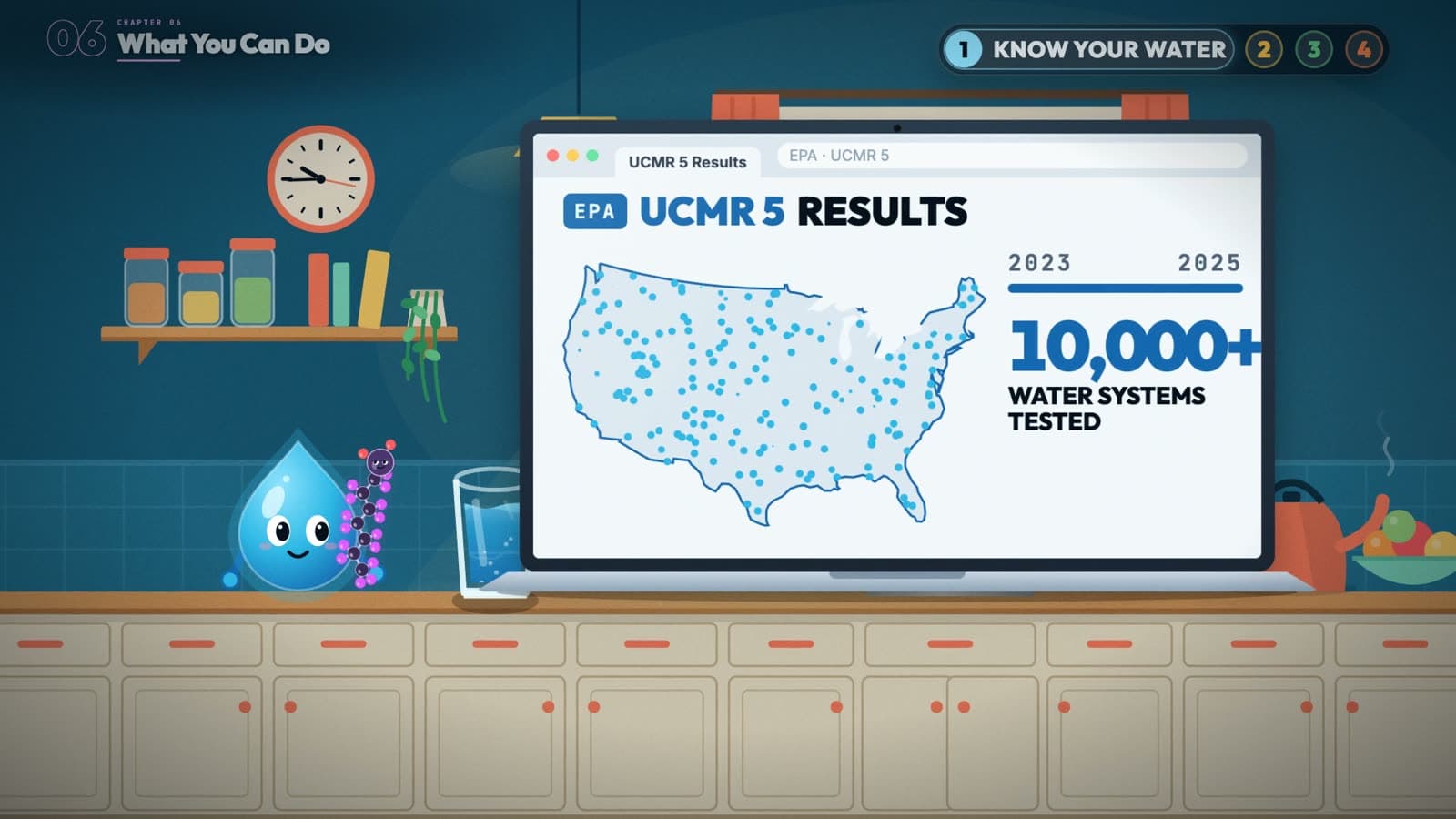
Look up your utility’s annual water quality report. Then check the EPA’s UCMR 5 results: from 2023 through 2025, more than 10,000 public water systems tested for 29 different PFAS. Search for “UCMR 5 Data Finder” and look up your system.
On a private well, nobody tests it but you. Find a certified lab that tests for PFAS, especially if you live near a military base, an airport, a factory or a landfill.
2Filter smart
If PFAS show up in your water, a home filter can help a lot, but not every filter works. Look for one certified to NSF/ANSI Standard 53 or 58 to reduce PFOA and PFOS, and change the cartridge on schedule. Try the filter check below.
3Cut other sources
Skip stain-repellent and waterproofing treatments you don’t really need. Look for products labeled PFAS-free. Check local fish advisories. And keep household dust down.
If you’ve lived near a known contamination site, or worked as a firefighter, ask your doctor about a PFAS blood test.
4Speak up
The rules are still being decided, so your voice matters. Ask your water utility what it’s doing about PFAS, and tell your elected officials what you think.
- public water systems tested for PFAS under UCMR 5 (2023–2025)
- 10,000+public water systems tested for PFAS under UCMR 5 (2023–2025)
- different PFAS in that testing
- 29different PFAS in that testing
- of systems had at least one location averaging above the 2024 limits
- About 8%of systems had at least one location averaging above the 2024 limits
Try it
Check your filter
Pick the kind of filter you have, then tick what you've confirmed about it.
If it's an activated carbon filter, a good one can work well, but results vary. Certification is how you tell.
Still to confirm: certified to nsf/ansi standard 53; certified to reduce pfoa and pfos; cartridge changed on schedule.
Try it
The boiling myth
Boil away some of the water and watch what happens to the PFAS level.
PFAS level
4.0 ppt
started at 4.0 ppt
Boiling doesn’t remove PFAS. The water leaves as steam; the PFAS stay behind, so the same amount ends up in less water.
CHAPTER 0716:28 in the video
Can We Destroy Them?
Here’s the strange twist in the PFAS story. The very thing that made these chemicals a miracle, their strength, is what makes them so hard to get rid of.
But the story isn’t over. Scientists are developing ways to destroy PFAS, using intense heat, electricity, and even chemistry that breaks some of them apart at temperatures not much hotter than boiling water.
Try it
Break the forever bond
Pick a method and break the molecule down.
Intense heat
Very high temperatures, 1,100 °C and up, can break the molecule apart.
All three are still being developed. The same strength that made PFAS a miracle is what makes them so hard to get rid of.
Blood levels of the oldest PFAS are falling. And the more people know, the faster that progress can go. So check your water, choose your filter wisely, and share this with someone who drinks water. Which is, you know, everyone.
QUICK QUIZ
What stuck?
Six questions. Every answer comes with the reason, right or wrong.
Question 1 of 6
What makes PFAS so hard for nature to break down?
SOURCES
Where these facts come from
Every fact in the video and on this page was checked against these sources on October 20, 2026. Rules and research keep moving, so check the newest version of anything you plan to act on.
Show all 28 sources
- U.S. EPA: PFAS National Primary Drinking Water Regulation, 89 FR 32532 (Apr 26, 2024)
- U.S. EPA news release (May 14, 2025): EPA announces it will keep maximum contaminant levels for PFOA, PFOS
- Federal Register, May 20, 2026: proposed rescission for PFHxS, PFNA, HFPO-DA and the Hazard Index (91 FR 29413) and proposed PFOA/PFOS compliance extension (91 FR 29425)
- AWWA & AMWA v. EPA, No. 24-1188 (D.C. Cir.): orders denying partial vacatur (Jan 21, 2026) and severance (Mar 19, 2026); oral argument Sept 18, 2026
- Chamber of Commerce v. EPA, No. 24-1193 (D.C. Cir., Aug 18, 2026): CERCLA hazardous-substance designation of PFOA and PFOS upheld
- U.S. EPA: Fifth Unregulated Contaminant Monitoring Rule (UCMR 5) Data Summary (July 2026) and Data Finder
- CDC/ATSDR: PFAS clinical overview and “PFAS in the U.S. population”; CDC National Report on Human Exposure to Environmental Chemicals (NHANES 1999–2018)
- Calafat et al. (2007), Environmental Health Perspectives: PFAS in the U.S. population, NHANES 2003–2004
- Smalling et al. (2023), Environment International (USGS): PFAS in U.S. tap water
- Cousins et al. (2022), Environmental Science & Technology: PFAS in rainwater and the planetary boundary
- National Academies of Sciences, Engineering, and Medicine (2022): Guidance on PFAS Exposure, Testing, and Clinical Follow-Up
- IARC Monographs Vol. 135 (Zahm et al., Lancet Oncology, 2023): PFOA (Group 1) and PFOS (Group 2B)
- U.S. EPA (2024): final toxicity assessments and MCLG support documents for PFOA and PFOS
- Li et al. (2018), Occupational & Environmental Medicine; Olsen et al. (2007), EHP: PFAS half-lives in people
- O'Hagan (2008), Chemical Society Reviews: the carbon–fluorine bond
- Science History Institute: Roy J. Plunkett; Lemelson Center: Patsy Sherman
- U.S. Patent 3,258,423 (1966): aqueous film-forming foam (U.S. Navy)
- U.S. EPA (2005): settlement with DuPont over PFOA reporting violations ($16.5 million)
- C8 Science Panel probable-link reports (2011–2012); Frisbee et al. (2009), EHP: the C8 Health Project
- Nathaniel Rich (2016), The New York Times Magazine: “The Lawyer Who Became DuPont's Worst Nightmare”
- ProPublica (2023): 3M scientist Kris Hansen and PFOS in blood-bank samples
- 3M and DuPont/Chemours/Corteva public water system settlements (2023); 3M 2025 Form 10-K
- U.S. EPA CompTox Chemicals Dashboard: PFASSTRUCTV6 list (2026)
- U.S. EPA: Reducing PFAS in Your Drinking Water with a Home Filter (2024); Identifying Drinking Water Filters Certified to Reduce PFAS
- Herkert et al. (2020), Environmental Science & Technology Letters: point-of-use filters and PFAS
- Minnesota Department of Health: home water treatment for PFAS (boiling does not remove PFAS)
- Minnesota Pollution Control Agency: Amara's Law; European Commission: Drinking Water Directive PFAS parameters (from Jan 12, 2026)
- U.S. EPA (2024/2026): Interim Guidance on the Destruction and Disposal of PFAS; Trang et al. (2022), Science: low-temperature mineralization of PFCAs
This lesson is for general education and isn't medical or legal advice. Talk to your doctor about PFAS blood testing if you've had high exposure, and check your local utility's data for your water.
KEEP GOING